

The need for this kind of plan is clear when a friend needs to prepare a marketing plan for his/her new business since a business plan plays a crucial role in educating it regarding its customers and stakeholders. It helps business strategizing not only in planning the communication approach but also in achieving realistic growth targets.
Starting a venture comprises far more than offering best-quality goods.
It is essential for one to know one’s consumers, how to attain customers, advertising approaches, and how results could be determined through measuring success. It’s quite tricky! The guide given here explains the indispensable elements needed while compiling each new business marketing plan.
Definition Snippet Block
The marketing plan acts as a written statement telling how the business is profitable to get their products/services into the market, get it to the right customers, fulfil their goals, and assess performance. It will participate the data, marketing policy, inexpensive, and activities plan into a single, operational article.
What Should She Include in a Marketing Plan for Her New Business?
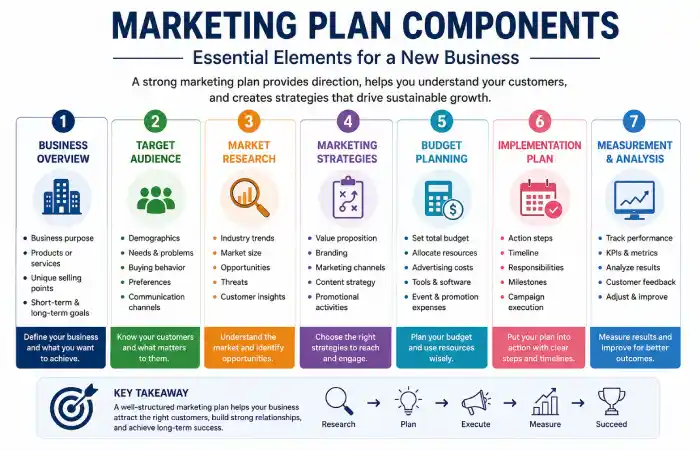
A complete marketing plan should cover several important areas:
- Business overview
- Target audience
- Market research
- Competitor analysis
- Marketing goals
- Promotional strategies
- Budget planning
- Performance tracking
Each part will allow the business to not only stop guesswork in decision making but to even take informed choices.
1. Business Overview & Marketing Objectives
The first section should explain what the business offers and what it wants to achieve.
It may include:
- Business name and purpose
- Products or services offered
- Unique selling points
- Short-term & long-term goals
Examples of marketing objectives:
- Increase brand awareness
- Gain new customers
- Improve online visibility
- Increase sales enquiries
- Build customer loyalty
The goal set must not be general; it must be more concrete and achievable.
2. Target Audience Research
Understanding customers is one of the most important parts of a marketing plan.
A business should identify:
| Customer Factor | Questions to Consider |
| Age group | Who is most likely to buy? |
| Location | Where are customers located? |
| Requirements | What problem does the produce solve? |
| Buying habits | How do they make purchasing decisions? |
| Preferences | What communication channels do they use? |
A local baker and an online software seller will have totally opposite marketing strategies since their customers and the manner they buy will differ.
3. Market & Competitor Analysis
A marketing plan should include research about the market environment.
This involves:
Understanding Competitors
Analyse:
- Similar businesses
- Their pricing
- Their strengths
- Their weaknesses
- Their marketing channels
Finding the Opportunities
Research can help to identify:
- Customer needs that are not being met
- New trends
- Areas where the business can stand out
Marketing Plan Workflow: Step-by-Step Process
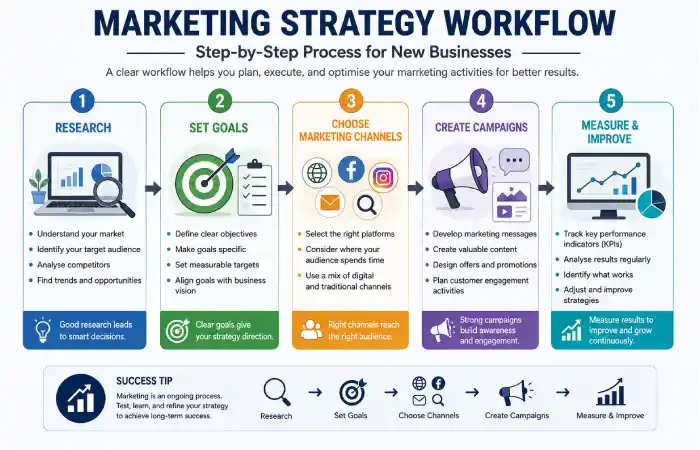
Step 1: Research
Collect information about:
- Customers
- Competitors
- Industry trends
Step 2: Set Goals
Define what the business wants to achieve.
Step 3: Choose Marketing Channels
Decide where to promote the business:
- Website
- Social media
- Email marketing
- Search engines
- Offline promotions
Step 4: Create Campaigns
Develop:
- Content ideas
- Advertising messages
- Offers
- Customer engagement activities
Step 5: Measure Results
Track:
- Sales
- Website visits
- Leads
- Customer responses
4. Marketing Strategies and Promotional Methods
A marketing plan should explain how the business will attract customers.
Common strategies include:
Digital Marketing
Examples:
- Search engine optimisation (SEO)
- Social media marketing
- Email campaigns
- Content marketing
Traditional Marketing
Examples:
- Flyers
- Networking events
- Local advertising
- Partnerships
Depending on who we want to reach and how much time we have, there are two main alternatives.
5. Budget Planning
A realistic marketing budget will prevent overspending.
A budget section may include:
| Marketing Activity | Example Cost Area |
| Advertising | Paid online campaigns |
| Website | Design and maintenance |
| Content creation | Articles, videos, graphics |
| Tools | Marketing software subscriptions |
| Events | Promotions and networking |
A business startup is not always a big budget requirement. Most of the time it’s all in consistency and of course picking the right channel that matters.
6. Performance Measurement & KPIs
A good marketing plan will describe what is success to be measured.
Common performance needles embrace:
- Website traffic
- Conversion rates
- Customer enquiries
- Social media engagement
- Sales growth
- Arrival on marketing venture
By tracking your results, you can make changes to get even better over time
Marketing Plan Components Comparison Table
| Marketing Approach | Best For | Limitation |
| Social media marketing | Building awareness and engagement | Requires consistent content |
| SEO | Long-term online visibility | Results usually take time |
| Paid advertising | Faster customer reach | Requires ongoing budget |
| Email marketing | Customer retention | Needs a quality subscriber list |
Realistic Expectations When Creating a Marketing Plan
A marketing plan does not guarantee immediate success.
New businesses should expect:
- Testing different strategies
- Learning customer preferences
- Adjusting campaigns
- Improving over time
Some marketing stations may produce quick results, while others necessitate months of consistent effort.
I want to establish the system to turn the predictions into long-term customers.
Common Errors to Avoid
A new business should avoid:
Trying to Reach Everyone
A focused audience usually produces better results than targeting everyone.
Ignoring Customer Feedback
Customer opinions can help improve products and messaging.
Not Tracking Results
Without measurement, it is difficult to know which strategies work.
Spending Too Much Too Early
Small businesses should test strategies before increasing investment.
Who Should Create a Marketing Plan?
A marketing plan is useful for:
- New business owners
- Entrepreneurs
- Small companies
- Freelancers
- Online businesses
- Local service providers
Even small businesses benefit from having clear marketing direction.
FAQ’s
Your friend is developing a marketing plan for her new business. What should she put in this plan?
When a friend is writing a marketing plan for her new undertaking, what must he add in that plan? A marketing plan must contain business objectives, target group minutiae, competitive study, marketing approaches, a budget, and actions of success.
Why is a marketing plan important for a new business?
A marketing strategy enables organizations to regulate customer preferences, develop effective promotional plans, and use promotion funds efficiently.
How often should a marketing plan be updated?
Marketing plans are regularly analysed, especially in situations where purchaser actions, rivalries, and overall business aim vary.
Does a small business need a marketing plan?
Yes, also for small businesses as a clear strategy should prevent random marketing moves.
Conclusion
If you’re the buddy of someone who is coming up with a marketing plan to launch their company, then what does the plan of my companion include? There would be a structured plan on customer, target, research, plan of promoting, price management and value.
Effective marketing plan not always final; Your approaches will change over time as you learn about who your customers are and who is in your market. If you set applied goals and make consistent adjustments, an advertising plan can play a critical role.