
Cloud computing is now an integral component of contemporary software development, business and digital transformation. The Droven.io AWS vs Azure comparison helps users to understand the differences between two major cloud providers. Amazon Web Services (AWS) & Microsoft Azure is compared in terms of services, pricing, security and use cases.
The choice of AWS or Azure is not about finding one “better” platform. It will be determined by company size, existing infrastructure, developer skills, and of course the type of workload and where you expect it to develop from here.
Definition Snippet: AWS vs Azure Comparison

Amazon Web Service area (AWS) and Microsoft Azure are mist service stages providing services including computing power, storage, databases, networking, artificial intelligence and security tools. Amazon web services or AWS are obtainable by the provider Amazon while Azure is a Microsoft product designed for business, developers and enterprise.
What Are AWS and Azure?
Amazon Web Services (AWS)
AWS is Amazon’s cloud platform thrown in 2006. It provides a wide range of cloud services including:
- Virtual servers
- Cloud storage
- Databases
- Machine learning tools
- Developer services
- Security solutions
AWS is widely used by startups, enterprises and technology companies because of its large service ecosystem.
Microsoft Azure
Microsoft Azure is Microsoft’s cloud computing platform launched in 2010. It offers similar cloud capabilities while providing strong integration with Microsoft products such as:
- Windows Server
- Microsoft 365
- Active Directory
- Enterprise software solutions
Azure is commonly used by organisations already working within the Microsoft ecosystem.
Droven.io AWS vs Azure Comparison: Key Differences
The Droven.io AWS vs Azure comparison highlights that both platforms provide powerful cloud infrastructure, but they differ in approach and strengths.
| Category | AWS | Azure |
| Provider | Amazon | Microsoft |
| Best known for | Broad cloud service range | Enterprise and hybrid cloud integration |
| Compute services | EC2 virtual machines | Azure Virtual Machines |
| Storage | Amazon S3 | Azure Blob Storage |
| Database options | RDS, DynamoDB, Aurora | SQL Database, Cosmos DB |
| Enterprise integration | Strong | Very strong with Microsoft tools |
| Learning curve | Can be complex due to many services | Familiar for Microsoft users |
Feature Comparison: AWS vs Azure
Computing Services
AWS offers EC2, where users have the flexibility of creating virtual servers.
Azure provides Windows-centric Virtual Machines.
Both platforms provide:
- Scalable infrastructure
- Multiple instance options
- Pay-as-you-use rating
Storage Capabilities
Cloud storage is essential for requests, backups and data organization.
| Storage Feature | AWS | Azure |
| Object storage | Amazon S3 | Azure Blob Storage |
| File storage | Elastic File System | Azure Files |
| Backup options | Multiple services | Integrated enterprise backup tools |
AWS has a very mature storage environment while Azure fits well for an MS heavy organisation.
Security Comparison
Both AWS and Azure provide advanced security features.
AWS Security
AWS includes:
- Identity and Access Management (IAM)
- Encryption tools
- Security monitoring services
Azure Security
Azure includes:
- Microsoft Entra ID integration
- Security management tools
- Compliance-focused solutions
Ultimately, the best security setup is configuration, administration and usage based and not platform specific.
Pricing Comparison
Cloud pricing can vary significantly depending on usage.
| Factor | AWS | Azure |
| Pricing style | Pay-as-you-go | Pay-as-you-go |
| Discounts | Reserved instances, savings plans | Reserved pricing, hybrid benefits |
| Cost management | Detailed tools available | Strong enterprise cost controls |
Users can depend on actual workload price comparisons, rather than simply pricing figures claims.
Workflow: How to Choose Between AWS and Azure
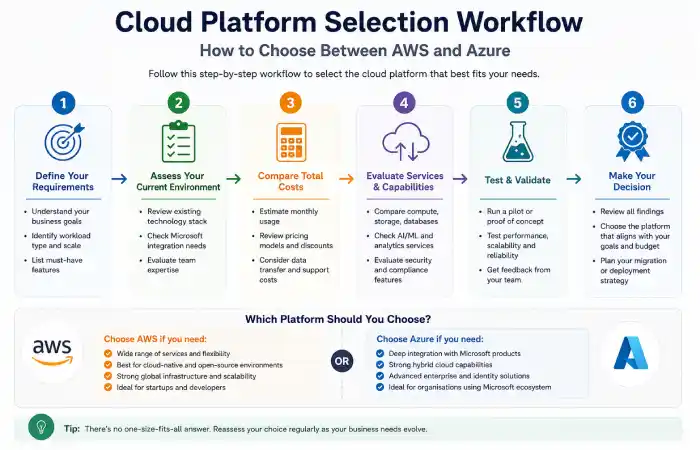
A practical choice process looks like this:
Step 1: Identify Your Workload
Regulate whether you need:
- Website hosting
- Data processing
- AI applications
- Enterprise software support
- Hybrid cloud systems
Step 2: Review Existing Technology
Consider your current environment:
- Microsoft-based businesses may find Azure easier
- Open-source and cloud-native teams may prefer AWS flexibility
Step 3: Compare Total Costs
Analyse:
- Monthly usage
- Data transfer fees
- Support requirements
- Scaling needs
Step 4: Test Before Migration
Many organisations run small projects or proof-of-concept deployments before making a full cloud decision.
Audience Persona: Who Should Choose AWS or Azure?
Startups and Developers
AWS may suit teams that want:
- Large service selection
- Flexible infrastructure
- Extensive developer tools
Enterprise Organisations
Azure may be attractive for companies that need:
- Microsoft integration
- Hybrid cloud options
- Enterprise identity management
Growing Digital Businesses
Both platforms can support growth, but the choice should match technical requirements rather than popularity.
Performance Expectations: What Users Should Realistically Expect
Both AWS and Azure can deliver strong performance when properly configured.
However, performance depends on:
- Application design
- Region selection
- Resource configuration
- Network setup
- Cost optimisation
A poorly configured cloud environment can perform badly on any platform.
Pros and Cons
AWS Pros
- Very large range of services
- Strong global infrastructure
- Mature cloud ecosystem
AWS Limitations
- Can feel complex for beginners
- Many services require technical knowledge
Azure Pros
- Excellent Microsoft integration
- Strong enterprise features
- Hybrid cloud capabilities
Azure Limitations
- Some services may feel less intuitive for non-Microsoft users
- Pricing can require careful management
Use Case Examples
Example 1: Online Application
A startup building a scalable web application may choose AWS because of its flexible infrastructure options.
Example 2: Corporate Software Environment
A company using Microsoft technologies may prefer Azure because of smoother integration.
Example 3: Data and AI Projects
Both platforms provide AI and analytics services, so selection depends on tools, expertise and budget.
Alternatives to AWS and Azure
Other cloud platforms include:
- Google Cloud Platform (GCP)
- Oracle Cloud Infrastructure
- IBM Cloud
Each platform has different strengths depending on business needs.
Final Recommendation by Use Case
| User Type | Recommended Option |
| Startup building cloud-native apps | AWS |
| Microsoft-focused enterprise | Azure |
| Hybrid cloud requirements | Azure |
| Wide range of cloud services | AWS |
| Beginners | Depends on existing experience |
There is no universal winner. The correct choice depends on your mechanical situation & purposes.
FAQ’s
What is the Droven.io AWS vs Azure comparison about?
The Droven.io AWS vs Azure comparison explains differences between AWS and Azure in terms of features, pricing, security, performance and use cases.
Is AWS better than Azure?
It may be argued that AWS offers a wider range of services than Azure and therefore would be more suited to individual users who need several different services while Azure may be more advantageous to a company that has many Microsoft applications.
Which is cheaper, AWS or Azure?
Cost depends on workload, usage patterns and discounts. Both platforms can be cost-effective when properly managed.
Is Azure easier than AWS?
Azure may feel easier for users familiar with Microsoft products, while AWS offers extensive flexibility for cloud developers.
Which cloud stage should businesses select?
Depending on their technology stack, budget, security requirements and long-term objectives, companies should…
Conclusion
Simply put, The Droven.io AWS vs Azure comparison illustrates that both cloud giants have proved to be a champion of sorts for the modern businesses as well as developers. In terms of services offered, AWS has an edge over Azure in terms of overall ecosystem and flexibility. Azure, on the other hand, wins over cloud warriors in terms of enterprise integration and hybrid cloud.
Rather than selecting the leading solution, organisations should consider their workload needs, technical skills, cost and growth plans going forward. The most appropriate cloud platform is the one that supports individual business needs.