
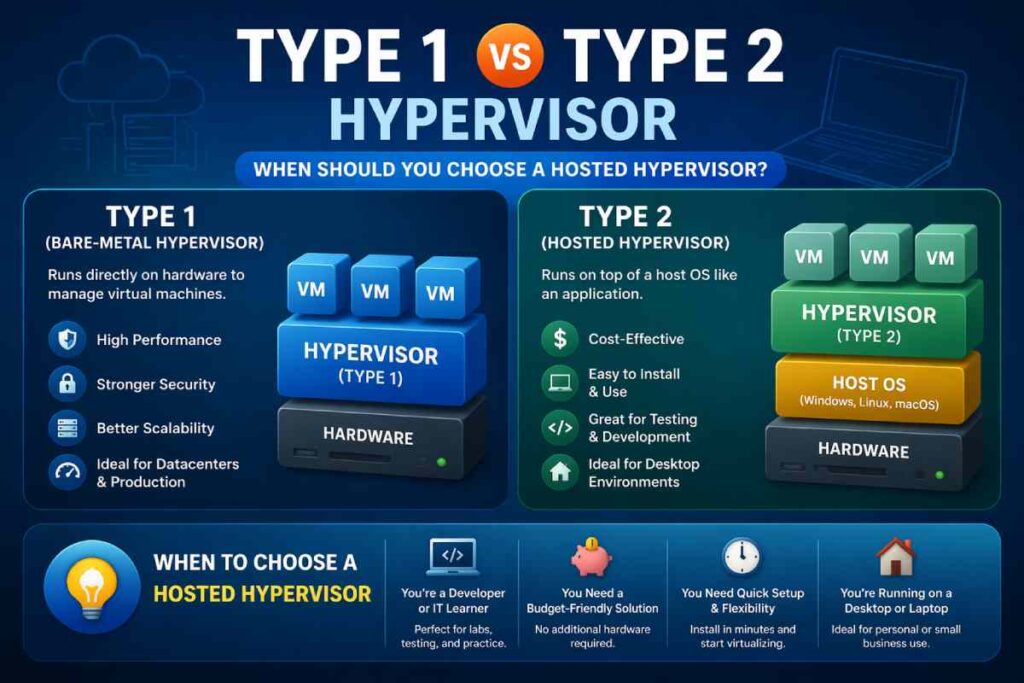
As workloads expand, management wants to move toward a hybrid cloud. Now the question comes up: What type of hypervisor should power the infrastructure?
A hypervisor lets you run multiple virtual machines on a single physical server. But how does it do that?
Whether it runs directly on the hardware or piggybacks on an existing OS changes everything about your hypervisor’s performance, security, and scale. That’s the type 1 vs type 2 hypervisor question, and it’s worth understanding before you commit.
What Is a Type 1 Hypervisor?
A Type 1, or bare metal hypervisor, runs directly on the physical hardware. There’s no host operating system underneath it. It manages resources itself, which means VMs get what they need without waiting in line behind another OS.
Because of these characteristics, Type 1 hypervisors are widely used in enterprise environments where stability and performance are non-negotiable.
Sangfor aSV is built on this model. It is a Type 1 hypervisor designed specifically for enterprise server virtualization, offering direct hardware access, optimized resource allocation, and a streamlined virtualization layer.
While it can operate within Sangfor’s broader HCI ecosystem, aSV itself is a complete and independent hypervisor solution, focused on compute virtualization.
What Is a Type 2 Hypervisor?
A Type 2 hypervisor runs as an application on top of a host OS. VirtualBox and VMware Workstation are the most familiar examples. The best part is that the setup is fast. You can install it like any other program and start spinning up VMs in minutes.
This makes Type 2 hypervisors suitable for:
- Developer environments
- OS testing and simulations
- Lightweight proof-of-concept setups
However, this convenience comes with trade-offs.
The trade-offs are real, though. Every VM call travels through the host OS first, which adds latency. If the host OS crashes or gets compromised, everything above it goes down.
But what about scaling?
You hit a ceiling quickly. Remember that it is not primarily designed for production-level workloads.
Type 1 vs Type 2 Hypervisor: Head-to-Head
Here’s how the two compare in a bare metal vs hosted hypervisor breakdown:
| Feature | Type 1 – Bare Metal | Type 2 – Hosted | Outcome |
| Performance | Direct hardware access, near-zero overhead | Host OS adds measurable latency on every VM call | Type 1 wins |
| Hypervisor security comparison | Strong VM isolation, no host OS exposure | Host OS vulnerabilities affect all VMs above it | Type 1 wins |
| Use Case | Production, enterprise data centers | Dev/test labs, desktop environments | Depends on need |
| Scalability | Built for large, growing deployments | Limited to the host machine’s capacity | Type 1 wins |
| Setup Time | Needs hardware planning upfront | Install and go, like any app | Type 2 wins |
| Best Pick | Sangfor aSV / HCI (aSV + aSAN + aNET + aSEC) | N/A – Sangfor offers better hybrid options | Sangfor HCI |
For enterprise environments, this virtualization performance comparison tells a clear story. Type 1 wins on performance, security, and scalability. Type 2’s only real edge is setup speed, which matters more to individual developers than IT teams managing production infrastructure.
Can a Type 2 Hypervisor Replace a Type 1 in Production?
In most cases, it cannot! The dependency on a host operating system introduces multiple risks:
- Performance degradation under heavy workloads
- Increased attack surface
- Single point of failure
As workloads scale, these limitations become more pronounced.
By contrast, Sangfor’s type 1 hypervisor (aSV) cuts through this entirely. It offers direct hardware access, with no host OS overhead, aSAN, and aNET handling storage and networking natively.
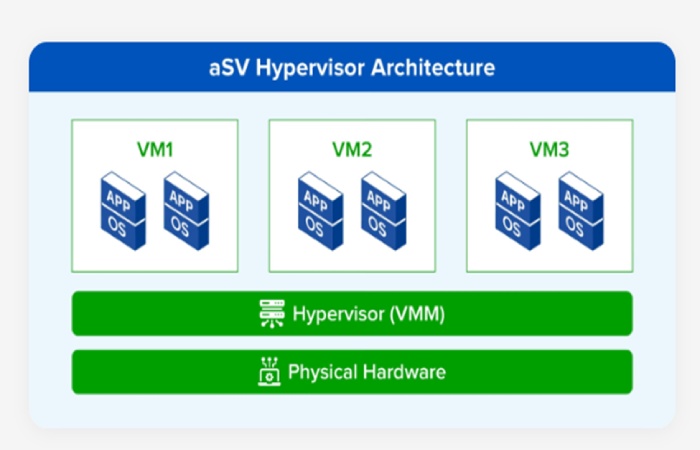
For mission-critical server virtualization, this virtualization architecture just performs better and shows consistency in performance.
Is a Hosted Hypervisor Secure Enough for Business Use?
For isolated, non-critical environments, a hosted hypervisor can be sufficiently secure.
However, in enterprise settings, the security requirements are significantly higher for:
- Financial data
- Customer information
- Regulated workloads
Because Type 2 hypervisors rely on the host OS, any vulnerability at that layer can expose all virtual machines.
Type 1 hypervisors, such as Sangfor aSV, mitigate this risk by operating directly on hardware, offering stronger isolation and a more controlled security posture.
When Does a Hosted Hypervisor Make Sense?
Type 2 hypervisor has legitimate use cases. The list of reasonable fits is endless, including:
- Development and testing environments
- Internal labs and training setups
- Early-stage proof-of-concept deployments
Budget plays a role as well. For a small business, this can be a practical starting point before investing in dedicated infrastructure. Just keep in mind that you may eventually outgrow it.
The risk with scaling Type 2 setups isn’t that it’s impossible. It’s that the performance ceiling usually hits at the worst time, and you end up doing a full rip-and-replace under pressure.
Sangfor aSV: A Focused Approach to Enterprise Virtualization
Sangfor aSV is designed with a clear objective: deliver high-performance, enterprise-grade server virtualization without unnecessary complexity.
Key Strengths of aSV:
- True Type 1 architecture with direct hardware interaction
- Optimized performance for demanding workloads
- Strong VM isolation for improved security
- Efficient resource utilization across virtual environments
- Simplified management without fragmented tooling
While aSV can integrate into Sangfor’s broader HCI platform, its core value lies in its ability to function as a standalone, reliable hypervisor for enterprise use.
While aSV can integrate with Sangfor’s broader platforms, such as HCI, VDI, and Sangfor Cloud, it delivers a secure, high-performance, and reliable foundation for compute virtualization.
What Do Real Users and Analysts Say?
Sangfor’s virtualization capabilities, including aSV, have received strong feedback across industry platforms.
* Recognized in the 2025 Gartner Market Guide for Server Virtualization Platforms.
Common themes in user feedback include:
- Ease of deployment and management
- Stable performance under enterprise workloads
- Responsive and reliable vendor support
These insights reinforce its positioning as a practical alternative for organizations modernizing their infrastructure.
Type 1 vs Type 2 hypervisor: What’s the Right Call?
So who wins in this hypervisor comparison?
Well, the decision ultimately depends on the use case.
- Choose Type 1 for production environments, scalable infrastructure, and business-critical workloads.
- Choose Type 2 for development, testing, and short-term experimentation.
For enterprises building long-term hybrid cloud strategies, Type 1 hypervisors provide a more stable and future-ready foundation. If you’re evaluating options, explore solutions like Sangfor aSV that reflect this direction while prioritizing performance, security, and operational simplicity without overcomplicating the virtualization layer.